
Five days ago, I sat on the veranda of a grand old country house and listened to the curator give a talk about the history of the place.
But it was not simply any old house. And its story wasn’t just any old history.
Te Waimate Mission House at Waimate North, nestled in farmland on a rural plateau in New Zealand’s Northland, was a place where histories and cultures had converged.
World history. British history. Māori history. National history.
My history.
And on that day, five days ago, my family history had come full circle. Not for the first time, either.
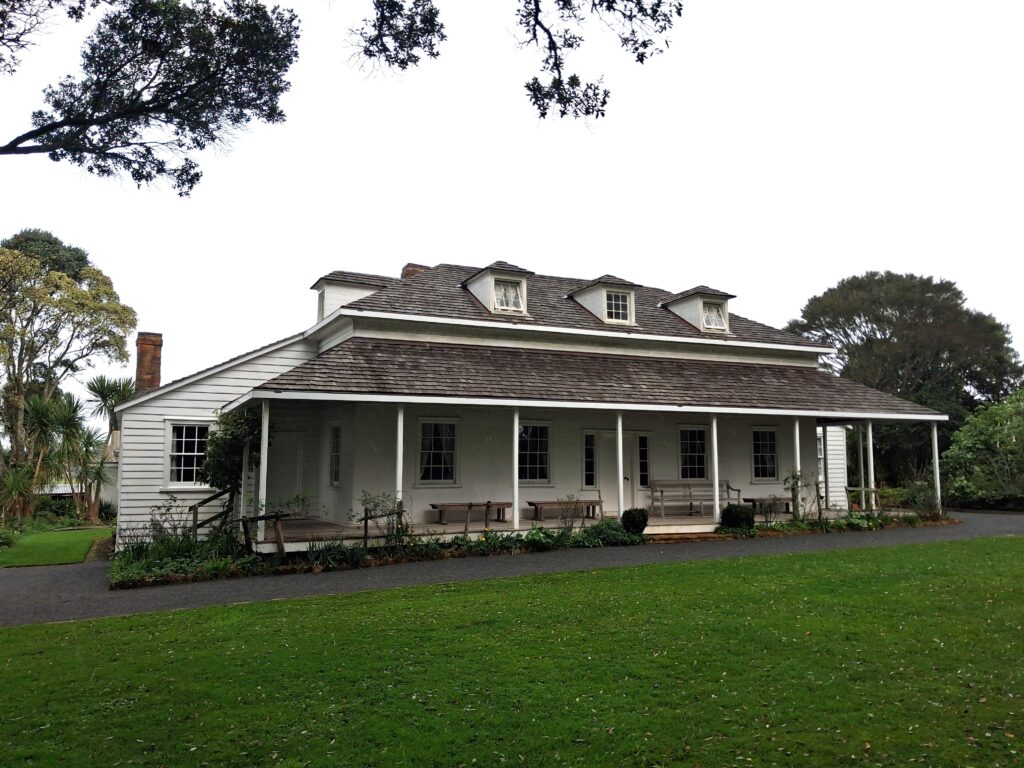
Te Waimate Mission Station, built in 1832 by the Church Missionary Society, is the second-oldest European building in New Zealand. For a short period, Te Waimate was a thriving community where Māori and Pakeha lived and where the missionaries established a model farm to grow food and teach European farming techniques. It was also the first location of St John’s College, an institution for training Anglican clergy.
Charles Darwin spent Christmas at Te Waimate in 1835. He wrote the following in a letter to his elder sister Caroline Darwin dated 27 December 1835:
Again we consumed three long weeks in crossing the sea to New Zealand, where we now shall stay 10 days. I am disappointed in New Zealand, both in the country & in its inhabitants. After the Tahitians the natives appear savages. The Missionaries have done much in improving their moral character, & still more in teaching them the arts of civilization. …. I walked to a country Mission 15 miles distant, & spent as merry & pleasant an evening with these austere men as ever I did in my life time.
Letter No. 30, Darwin Online, www.darwin-online.org.uk
Te Waimate was the site of the second signing of Te Tiriti o Waitangi, on 9–10 February 1840. Seven rangatira of Ngāpuhi added their signatures at Te Waimate. This was the treaty signed between the British Crown and Māori rangatira that became the founding document of the fledgling nation of New Zealand. (It, and the promises it contained, was also ignored almost immediately after the ink had dried. See 1845, below.)
The footsteps of family history
This was the place where, in June 1845, my great-great-great-grandfather Corporal John Cherrington had marched in and set up camp with 600 other British soldiers, including his comrades of the 58th Regiment of Foot, under the command of Lieutenant Colonel Henry Despard. It was the place where he returned with wounded soldiers after the British had been routed at Ōhaeawai Pā, and where five of those wounded succumbed to their injuries and were buried in the Mission cemetery.
And it was where he left in December 1845 to march on Ruapekapeka Pā, where a victory, of sorts, awaited the British.
Little did he know.
Little did John Cherrington know that after taking his discharge from the Army in 1846, he would settle in Kawakawa and marry the daughter of Te Aho, a brother-in-law of Kawiti, the formidable opponent who had led the fight against the British at both Ōhaeawai and Ruapekapeka.
Little did he know that his grandson, Wiremu Hone Keretene, an Anglican minister who would go on to become only the second Māori to be given the title of canon, would be posted to Te Waimate in the early years of the following century.
Little did he know that his great-grandson Hoterene Te Rangaihi Keretene would be born at Te Waimate in 1910.
And little did he know that his great-great-granddaughter would visit Te Waimate in May 2026, five days ago, for the first time.
With me, my sister, and my cousin – his great-great-great-grandchildren.
The wait
How much of the history of a place is about leaving and returning? And how much of it is about waiting for the next return?
I had visited Te Waimate perhaps twenty years earlier, interested but unaware of the significance of the place to my family’s history.
But this time – this visit, this return – I felt the weight of history on me. Not only the history of the birth pangs of a nation – promises made then swiftly broken, peace rapidly eclipsed by war – but also the story of my family, intertwined with that same history.
It was a comfortable weight, though. A heavy blanket, perhaps, that reminded me of the story of the ground upon which I stood.
Ground trodden by my grandfather, my great-grandfather, and my great-great-great-grandfather.
And now, 180 years after Corporal John Cherrington, by my mother and three of the next generation.
It was worth the wait.
Comments are closed.